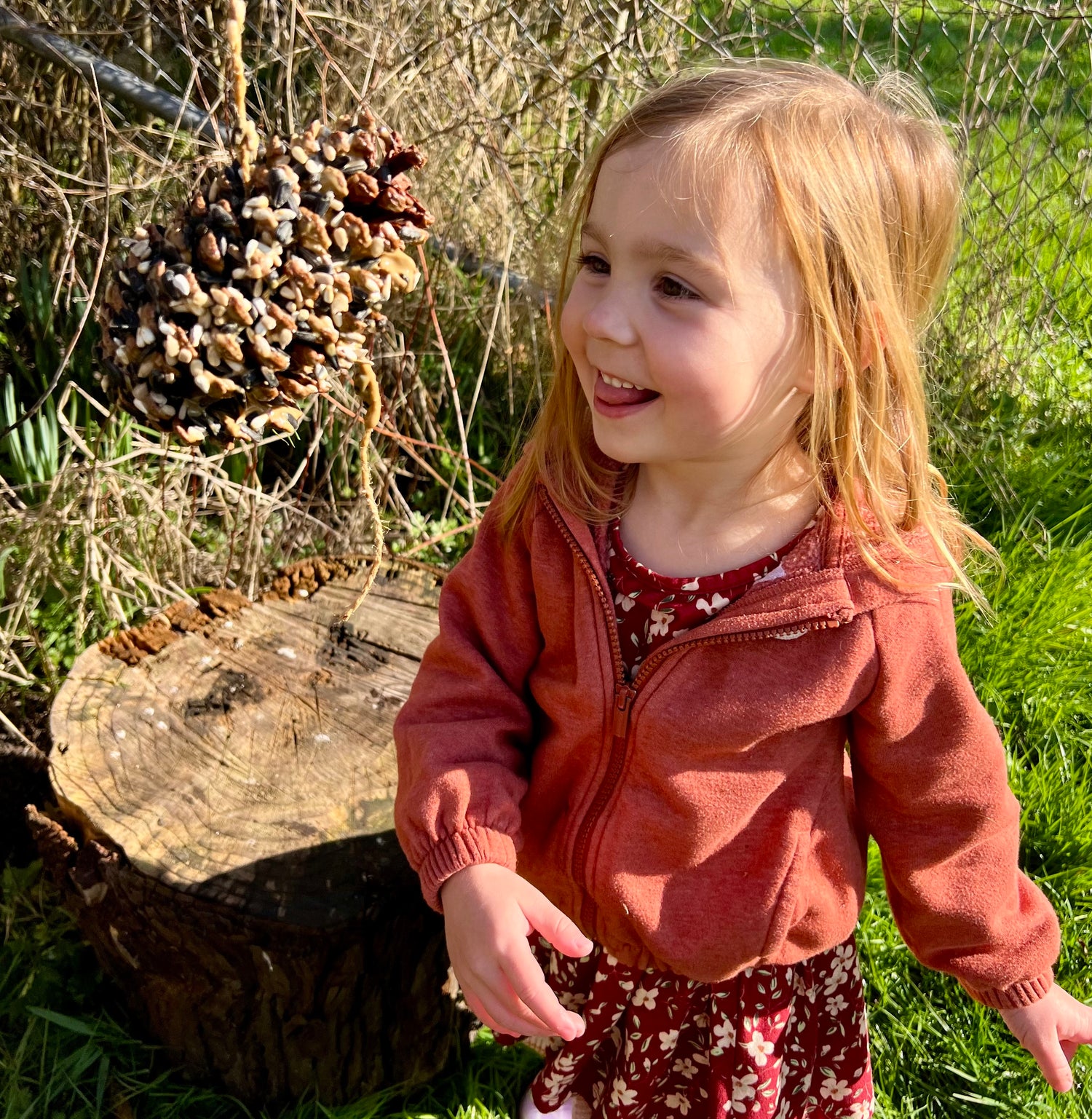
If you're looking for an activity that benefits (and encourages) physical and mental health for kids, look no further than birds. Whether it's a walk in nature with a pair of binoculars, the thrill of seeing a new bird or the quiet peace of a backyard full of birdsong, the benefits are many.
Some (most, really) of the best things in life are also the simplest. A bird at the feeder. A child asking what kind it is. The quiet wonder that follows when you stop to watch.
Birds have a way of pulling people out of their heads and into the present moment. For kids especially, that's not a small thing. And for busy parents and caregivers, it works the same way. The sight and sound of birds just being birds is some of the best stress relief there is.
Why Birds Are Good for Kids
The research on children, nature, and mental health is clear and growing. Time in nature, even small, everyday doses of it, is associated with lower anxiety, better attention, improved mood, and stronger emotional resilience in children. A 2025 systematic review published in Environmental Research examined 25 studies specifically on biodiversity and children's wellbeing and found consistent associations between exposure to nature and positive outcomes across mental health, cognitive functioning, and play.
Birds, specifically, have a particular gift for capturing children's attention in a way that other nature experiences don't always manage. They move. They sing. They have names and personalities and habits. They give a child something specific to notice, remember, and look for again.
That quality of specific, curious attention (what researchers sometimes call fascination) is exactly the kind of mental state that allows an overstimulated, task-fatigued brain to reset. For children growing up in a world of screens and schedules, a bird at the feeder is a genuinely different kind of experience. Present. Unpredictable. Free. And fascinating.
Birding as a Family
One of the things we love about birds as a family activity is that there's no skill gap. A five year old and a fifty year old are equally capable of being delighted by a cardinal at the feeder. No one needs to be the expert. Everyone gets to wonder.
That equality is rarer than it sounds in activities that parents and children do together. Birding doesn't require anyone to slow down or speed up, to be patient with a beginner, or to pretend something is more exciting than it is. The birds do all the work.
A few things that make birding work beautifully as a family activity:
A feeder outside a window is a starting point that requires almost nothing — no special equipment, no planning, no good weather. The birds arrive on their own schedule and everyone gets to be surprised and fascinated.
A simple field guide or birding app turns every sighting into a small discovery. What is it? Where does it live? What does it eat? Children (and adults) who may otherwise be resistant to learning will absorb an astonishing amount of information about birds without noticing they're doing it.
Citizen science programs like eBird and the Great Backyard Bird Count invite families to contribute real data to real research. Children find this genuinely exciting — the idea that what they see from their own window actually matters to scientists.
And the conversations that happen while watching birds — about nature, about seasons, about where birds go and why, about why we should care for the things that can't speak for themselves — are some of the best ones.
Birds in the Classroom
A feeder outside a classroom window is one of the most underrated teaching tools there is.
It requires no curriculum, no budget to speak of, and no special expertise from the teacher. It just requires a feeder, good seed, and a window. What happens next takes care of itself.
Birds in the classroom support science learning naturally — observation, identification, seasonal patterns, habitat, food chains. They support language and literacy — bird names, descriptions, journal entries, stories. They support emotional regulation — the quiet focus of watching a bird, the shared excitement of a new species, the mindfulness of just being still and paying attention.
Research on nature-based learning consistently shows that children who have regular contact with nature, even through a window, demonstrate better concentration, lower stress, and stronger engagement with their schoolwork.
For schools, daycares, and Montessori programs that are peanut-free environments, a classroom feeder has historically presented a problem: conventional birdseed almost universally contains peanuts, may contain peanuts due to cross-contact, or is processed in facilities that also process peanuts. And unlike human food, allergen labelling on pet food including birdseed is voluntary, so you often can't know what's in it even if you read the label carefully.
Wallis Johns exists, in part, for exactly this reason. Our birdseed is certified peanut-free, tested and verified by a third-party accredited lab. Safe for classrooms. Safe for peanut-free environments. And because it’s not just peanut-free birdseed, it’s really, really great birdseed (no fillers, ever), it will actually attract birds to those feeders.
If you're a school, daycare, nature centre, or community organization, we also offer an Educational & Community Program with discounted pricing for approved institutions. You can learn more about it here.
Things to Do With Kids and Birds
Beyond the feeder, there are so many ways to bring birds into a child's world. Here are a few we love.
Make a pine cone bird feeder
This is a classic for a reason. Roll a pine cone in peanut butter — for peanut-free households and classrooms, unsalted sunflower seed butter works great — then roll it in birdseed and hang it outside. Kids can watch the birds discover it, it's a genuinely satisfying, and a lot of fun, thing to make.
Mila will show you how to, step-by-step, make one here.
Keep a bird journal
A simple notebook where children draw or write about the birds they see. What did it look like? What was it doing? Did it come back? Over time a bird journal becomes a record of seasons, a practice of observation, and a source of real pride.
Download a birding app
Apps like Merlin Bird ID (free, from Cornell Lab of Ornithology) identify birds by photo or sound. Children find it magical that their phone can listen to a bird and tell them what it is. It also opens up birding anywhere - a backyard, a park, a walk to school.
Join the Great Backyard Bird Count
Held every February, this is a worldwide citizen science event where anyone can count the birds they see and submit the data. Children love contributing to something real. And it's free.
Plant for the birds
If you have outdoor space, even a small one, native plants that produce seeds and berries give birds a natural food source beyond the feeder. Leaving seed heads on plants over winter rather than cutting them back is one of the simplest things you can do. Children who help choose and plant these are learning something that lasts.
Go on a bird walk
A local park, a nature trail, even a walk around the block with a field guide. The goal isn't to find rare birds, it’s to notice what's already there. Children who learn to see birds see the world differently. That's not an exaggeration.
Frequently Asked Questions
What age is birding appropriate for?
All of them! Babies respond to birdsong. Toddlers love the movement and colour. School-age children can learn identification and start keeping lists. Teenagers, perhaps counterintuitively, often find birding genuinely absorbing once they give it a chance. It rewards patience and attention in a way that feels earned. And for teenagers especially, it can provide a sense of community and of finding their flock when it's needed most.
How do I get a child interested in birds?
Start with a feeder outside a window they can see from somewhere they spend time, a bedroom, a kitchen, a classroom. Let them notice on their own terms. Don't quiz them or turn it into a lesson. Just let the birds do what birds do. The curiosity usually arrives without much encouragement.
Is birdseed safe for classrooms and peanut-free environments?
Conventional birdseed is not reliably safe for peanut-free environments — most contains peanuts, may contain peanuts due to cross-contact, or is processed in facilities that also handle peanuts. Allergen labelling on birdseed is voluntary, which makes it difficult to know what you're actually getting.
Wallis Johns birdseed is certified peanut-free, tested and verified by a third-party accredited lab. It’s specifically designed for use in peanut-free settings including schools, daycares, and nature centres.
You can learn more about why peanut-free matters here.
What is the best birdseed for attracting birds to a classroom or backyard feeder?
Premium, filler-free seed blends are always the best choice, not blends padded with filler seeds like corn, milo, and wheat that birds largely ignore. Our Something for Everyone blends are formulated to attract the widest variety of seed-eating backyard birds, coast to coast, all year long. No fillers. Ever.
Can children help with a classroom or backyard feeder?
Absolutely, and they should. Filling the feeder, taking care of it (washing it every few weeks is super important), keeping a record of what birds visit, drawing the birds - all of it gives children a sense of responsibility and connection. The birds that come to rely on a feeder are real. The care children give them is real too.
What is the Great Backyard Bird Count?
The Great Backyard Bird Count is a free, annual citizen science event held every February, organized by Cornell Lab of Ornithology and the National Audubon Society. Participants count the birds they see over at least 15 minutes and submit their observations online. The data contributes to real research on bird populations. Children find it genuinely meaningful to participate, and it's one of the largest citizen science events in the world.